


Secure Future Jobs – Update yourself
India’s growing economy and technical landscape have placed the nation on the verge of a drone revolution. Drones or unmanned aerial vehicles (UAVs) have enormous potential to stimulate economic growth, alter a variety of industries and create a significant number of job possibilities. The Indian drone market is expected to grow exponentially with new applications, legislative reforms and technical advancements, given the government’s focus on ‘Make in India’ and digital transformation.
The drone market has the potential to grow GDP, improve productivity in industry and create a variety of jobs in manufacturing, operations, maintenance, technology research and regulatory compliance.
1. The Present Scenario of the Indian Drone Industry
The drone market in India is still young yet it is raising positive signals of fast growth. The Drone Rules 2021 are part of the government’s proactive approach to deregulate, innovate and attract investors. The civil aviation ministry has granted thousands of drone registrations and numerous startups and established enterprises are pursuing drone manufacturing, services and research.
Drones are employed in many important industries such as agricultural, defense, infrastructure, surveillance, disaster management, insurance, and delivery. The government has also created programs like the Drone Shakti project announced by Mr. Rajnath Singh, aimed at boosting the domestic manufacturing of drones, which is a matter of inventiveness and independence.
2. Indian Drone Market: Potential Market Size and Growth Projections
According to industry estimations, the Indian drone market is estimated to have a CAGR of more than 20-25% YoY over the next 10 years with a potential to reach a value of USD 2-3 billion by 2030. This growth will be driven by:
In agriculture, monitoring and spraying of crops are becoming more widespread. Infrastructure and construction are growing sectors. defense policy and modernization. Aerial photography, mapping and surveillance are more and more required. The logistics and e-commerce industries are looking into drone deliveries.
Key Growth Drivers
Changes in regulations – such as simplified drone regulations and licensing procedures. Technological innovation is the cost-effective creation of locally produced drones with state-of-the-art technology. The government has taken several initiatives to promote local manufacturing such as Make in India and Atamnirbhar Bharat policies. Private sector investment such as increased capital investment and start-up activities. Demand is increasing in the market in rural and urban areas.
3. Economic Benefits of the Drone Industry to India’s Growing Agricultural Production
India’s economy is still strongly dependent on agriculture, with about half of the labor force employed in it. Drones have the potential to alter farming by enabling precision agriculture practices such as monitoring crop health, soil conditions, and the efficient use of fertilizers and pesticides. By reducing the cost of input and improving the output, this strategy can directly enhance the rural income and the nation’s GDP. Urban Design & Infrastructure Development Drones can be used for rapid surveying, mapping and monitoring of roads, bridges and urban development projects. It reduces project schedules and costs . It increases infrastructure growth – which is critical to economic development .
Emergency Management and Public Safety
India is prone to natural disasters in the form of Earthquake, Cyclones and Floods. Drones can save lives and save financial losses by aiding in catastrophe assessment, rescue operations and distribution of relief goods. Strategic Capabilities & Defence
The Indian military is increasingly deploying drones for surveillance, fighting and reconnaissance. The domestic production of drones under the military production policy can increase the contribution of the military sector to the GDP and create high-value jobs. Commercial and Logistical Areas
New drone delivery services could create new business opportunities, especially in distant and hard-to-reach locations. In e-commerce, drones can be used for last mile delivery to improve the quality of services and minimize logistic costs.
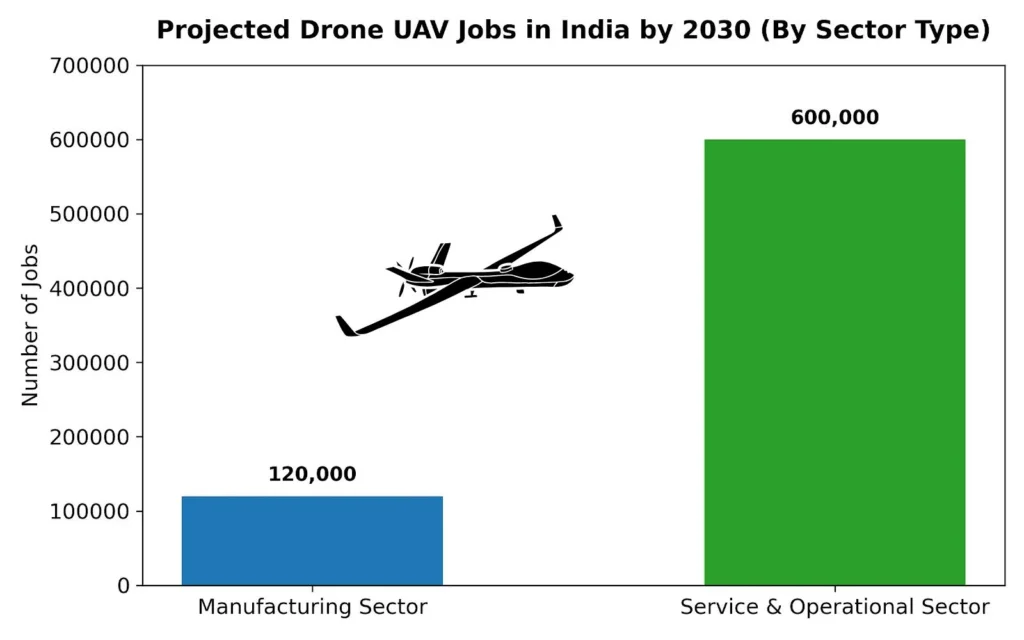
4. Indian Drone Industry and Employment Generation
The drone business is ready for expansion and with that comes a wealth of job opportunities in a number of different industries:
A. Building and Manufacturing
All batteries, controllers, sensors and drone hardware are designed and manufactured locally. Alternative careers include manufacturing, supply chain management, quality assurance, design engineering and assembly line positions. Future prospects: With rising demand, India can build a strong manufacturing hub and lessen its dependency on imports.
B. R&D (Research and Development)Innovation Hubs are R&D centers focused on advanced drone technology, AI integration, payload development and autonomous operations. Skilled vocations include software developers, scientists, engineers and data analysts. Companies and universities are working on innovative research projects.
C. Operations and Service Providers
Farm service providers include drone pilots, farm managers and agronomists. Infrastructure inspection is conducted by surveyors, GIS analysts and maintenance professionals. Emergency responders: Who is authorized to fly drones in a disaster
D. Contexte juridique et politique
Regulatory bodies require employees to be trained in compliance, safety and licensing. Training centers are places where abilities of piloting drones are created, supported and enhanced. As the rules change , there will be a new set of experts to control the drone airspace and keep it safe .
E. Supporting Sectors
Things like mapping tools, AI algorithms, and aerial data are data analytics and software development. Workshops, training courses and certification programs are examples of education and training. Examples of financial and insurance services include risk assessment, insurance programs, and leasing models.
5. Obstacles to Fulfilling Potential
However, there are some obstacles to be addressed in the bright future of drone business of India:
Regulatory Barriers
Despite the recent revisions, there is still a need for comprehensive, uniform and unambiguous legislation that would assist corporate activities, especially in urban locations.
Poor Infrastructure and Skills
Lack of infrastructure and specialised training facilities for operations and drone production may hamper expansion.
Cost and availability
Advanced drones are pricey and may not be available to startups or small-scale farmers, which might slow adoption.
Technical Constraints
Technological challenges include battery life, cargo capacity, and weather sensitivity.
Privacy and Public Acceptance Concerns
For large scale deployment safety, perceptions and privacy rights all need to be addressed.
6. Prospects and Policy Initiatives
The Indian government has taken the following proactive initiatives for the development of drone technology:
Drone Rules 2021: More flexibility to fly and easier licensing process. Drone Shakti is a scheme for promotion of indigenous manufacture. One of the examples is skills development, for instance youth programs teaching drone technology. A case in point is the development of drone corridors and test beds as a public-private cooperation.
India eyes becoming a global drone innovation and manufacturing hub in the future with the industry making substantial contribution to GDP and jobs.
7. Conclusion: India’s Transformative Potential
India’s drone sector is set for a bright future, capable of revolutionizing several industries, spurring economic growth and generating millions of jobs. India can be a leader in the global drone ecosystem with talent development, enabling laws and technology innovation.
But, government agencies, corporate stakeholders, academics and society must work together to attain this goal. For India to realize the full benefits of drones for economic and social development, legislative hurdles need to be cleared, infrastructural investment made, innovation encouraged and inclusivity ensured.